Diverax · A written exchange
Everything Except Table Tennis
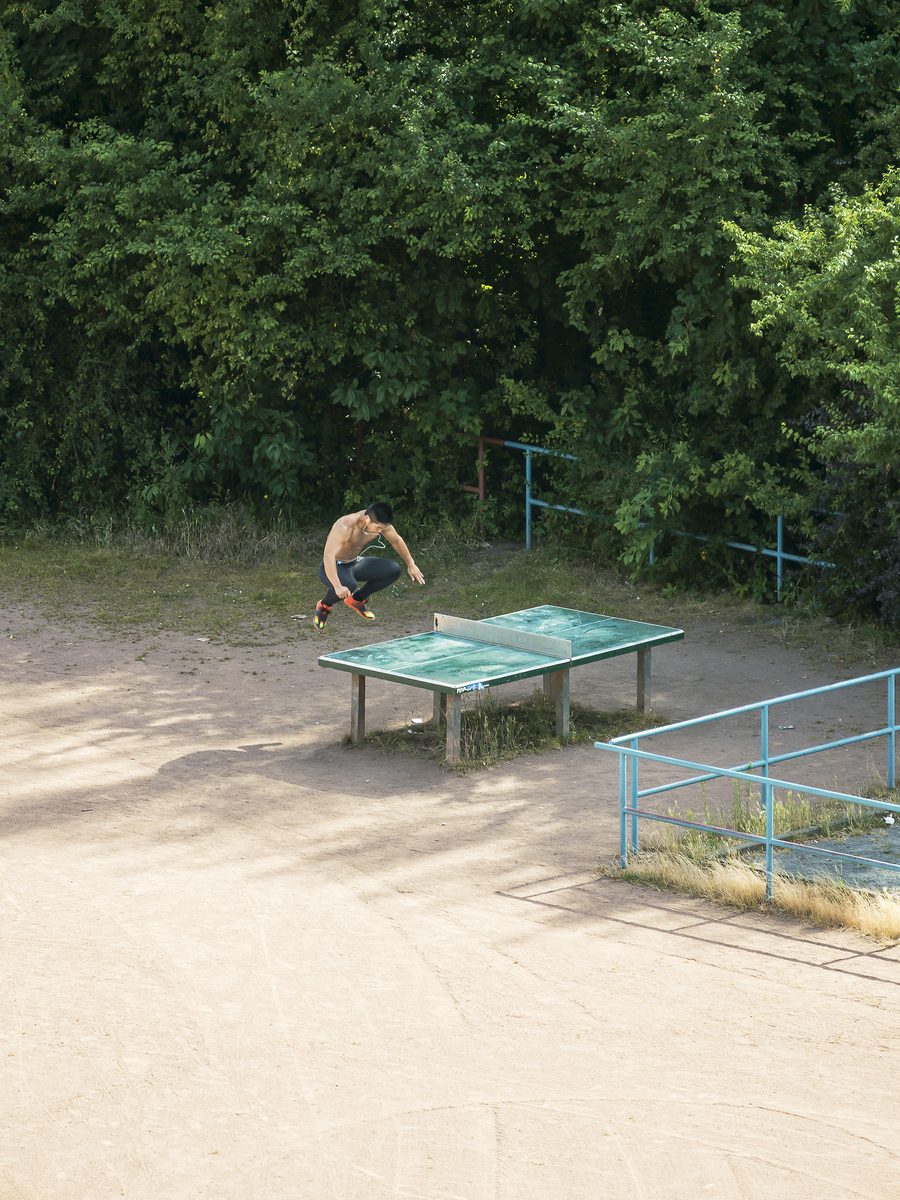
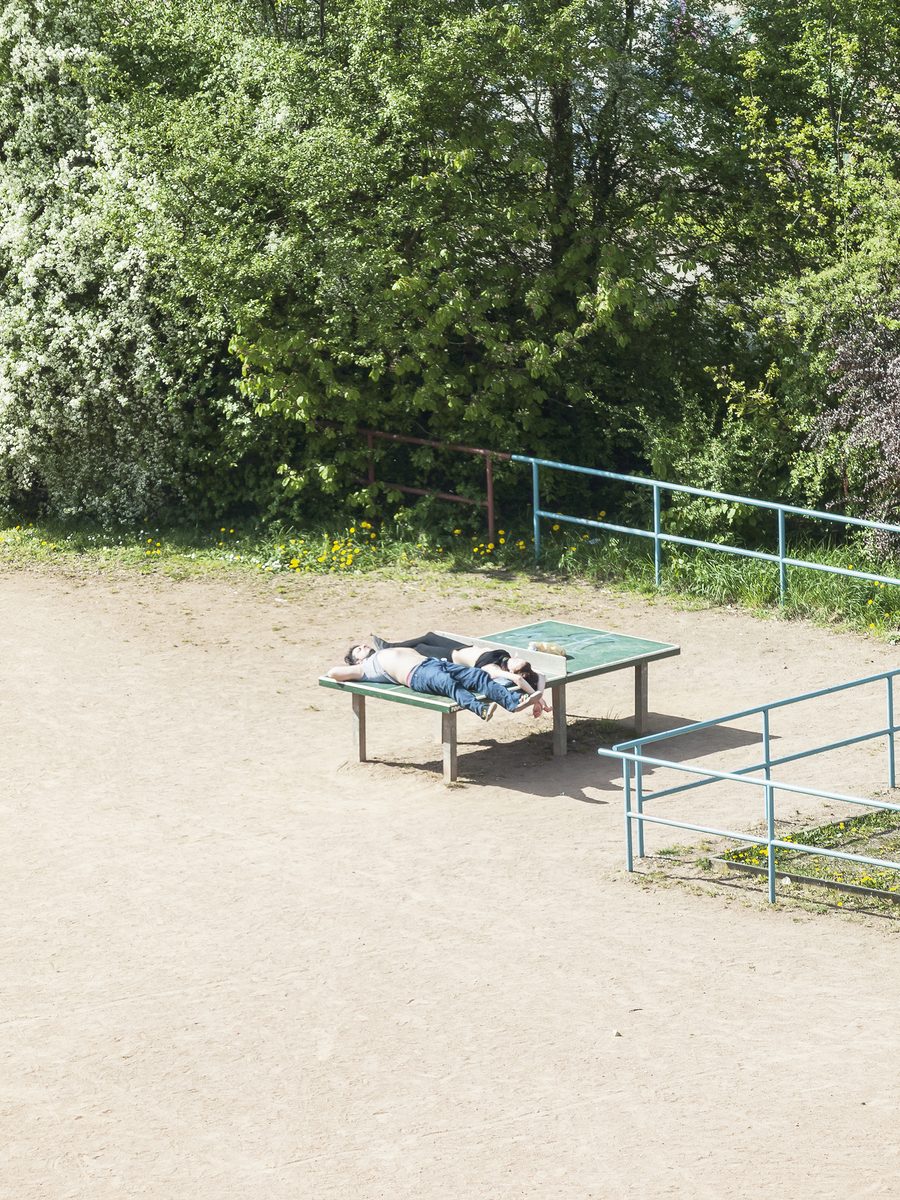
For five years Hayahisa Tomiyasu photographed a single ping-pong table in Leipzig from his window. People sunbathed on it, dried laundry on it, changed nappies on it, slept on it. Is that a failure, or the moment a public object finally starts working?
Interview by Alexander Hung · Taipei, September 2026
From TTP, 2012–2016 Images © Hayahisa Tomiyasu
I came to Hayahisa Tomiyasu’s work from an unusual direction. I work in sports culture, so what I saw first was not a photograph but a piece of sports infrastructure that almost never gets used for sport.
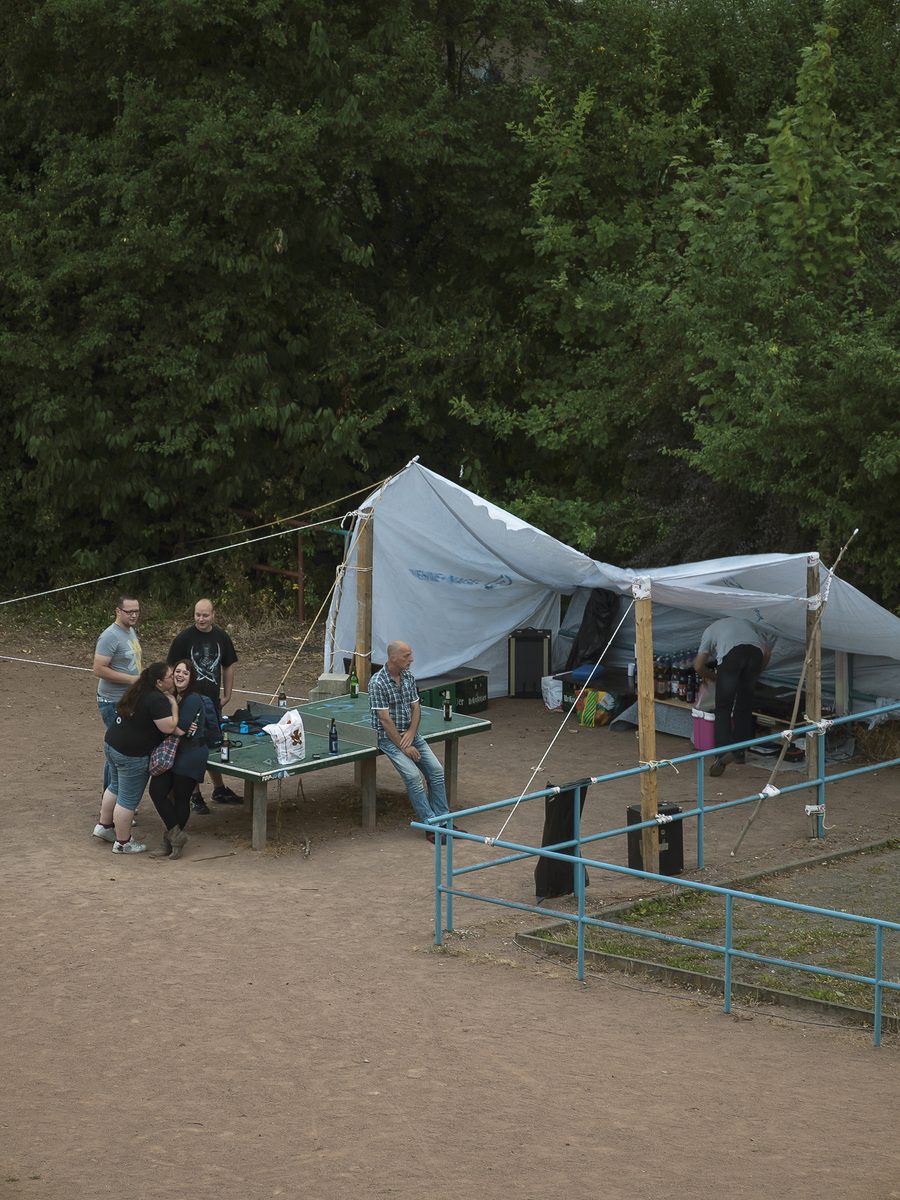
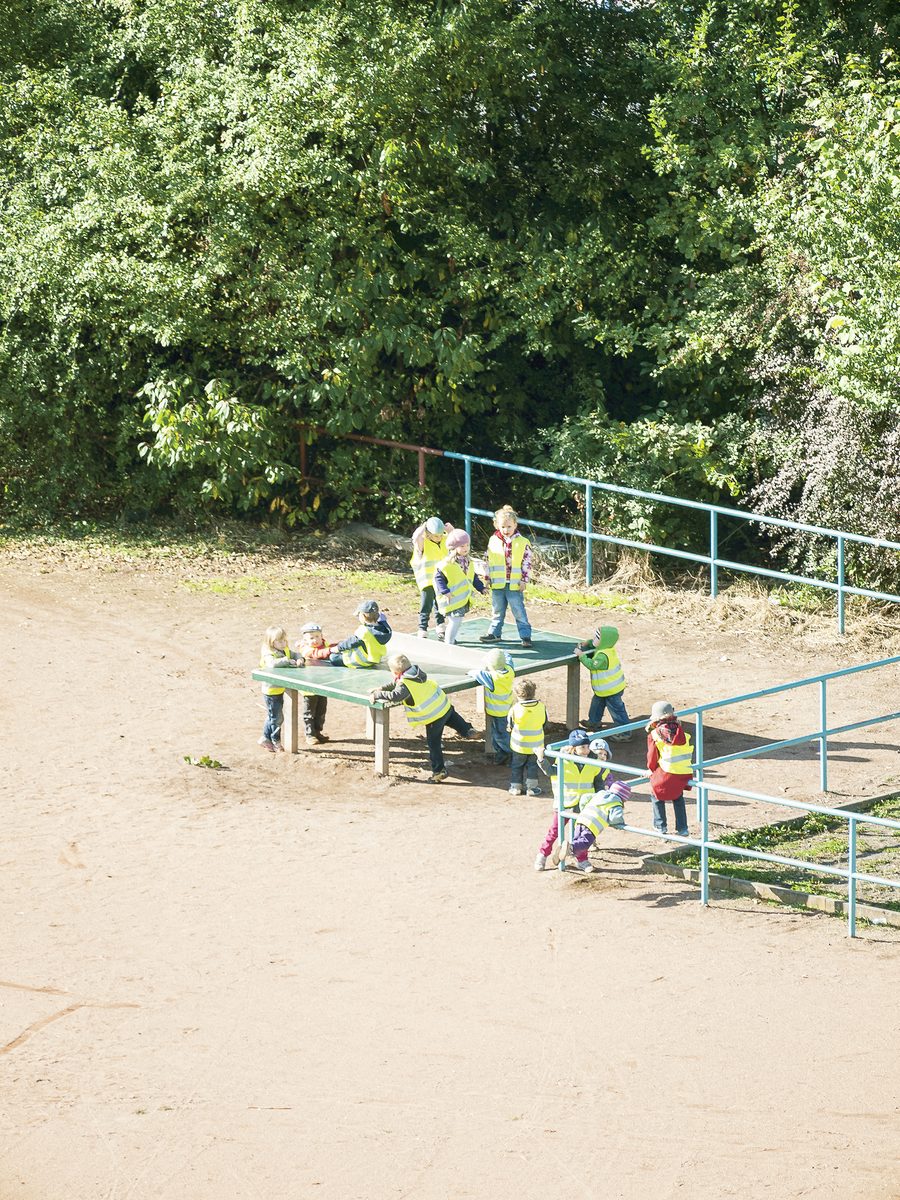
TTP — Tischtennisplatte, German for table-tennis table — was made between 2012 and 2016 from the window of a student apartment in Leipzig, eight floors above a sports plaza. The camera stayed in more or less the same position on the windowsill, shifting slightly to the right or left depending on what was happening around the table. Over those years the table below became a sunbed, a laundry counter, a nappy-changing station, a climbing frame, a bar, a bed. The book that came out of it runs to 260 pages and won the MACK First Book Award in 2018. This spring a documentary film festival used the pictures as its identity.
He did not set out to photograph the table. He set out to photograph a fox, which crossed the field one afternoon, stopped at the table, looked at it, and never came back. The waiting became the work.
What I wanted to ask him about was the thing a city planner would file as a failure. A facility is built for one activity. Nobody performs that activity. The facility is nonetheless in constant, inventive, daily use. Is that a failure, or is that the moment the thing finally starts working?
I sent nine questions. He asked to answer in writing rather than on a call — he said he could think more carefully that way — and what came back is printed below as he wrote it.
One thing I did not know when I first wrote to him only surfaced in his answers, and it is the reason this exchange is running here rather than anywhere else. Tomiyasu lived in Taipei for about four years as a child. He had not been back since.
1. Before I ask about the work itself: you have been answering questions about a ping-pong table for eight years now. This spring it became the face of a documentary film festival — Visions du Réel used TTP for its identity, and the series was shown at Grand-Champ in Gland. I am curious what that is like. Does a work that keeps coming back become a companion, or a room you cannot leave?
One of the major characteristics of this work is how broad its “entry point” is. It has attracted interest not only from people working with photography, but also from people in other fields such as design, architecture, music, and film.
Personally, I feel that the work left my hands the moment it was published as a book. Since then, it has made connections with people I don’t know and with fields I never expected it to come into contact with, and every now and then it seems to temporarily return to me from somewhere else.
2. You began at the window, waiting for a fox that never came back — and Fuchs eventually became a work of its own. I am interested in what it does to a project to be founded on something that did not happen. Do you think of Fuchs and TTP as two halves of one piece — the thing you were looking for and the thing you found instead — or does one of them feel like the honest work and the other like a by-product?
Neither of these subjects was something I was looking for. They were simply things that happened to occur in front of me by chance. I happened to photograph them, and then gradually continued taking pictures without having any particular larger purpose in mind.
Fuchs occupies something like a prologue to TTP, and the two works complement each other within their respective processes of making. Each can stand on its own as an independent work, but one advantage of presenting the two together is that they can also answer the question that often comes up when people encounter TTP: “Why did you start observing a ping-pong table in the first place?”
Fuchs explains the motivation that led me to begin TTP, while TTP teaches me to pay attention to the contingency of what happened.
3. You have said that you did not create stories about the people — that you were “just taking photographs like a machine”. But the book runs to 260 pages and has a clear sequence: the table disappears twice, and at the end it is lifted away in a harness. That ending is a decision. Where did authorship actually enter this work — at the window, or at the edit?
I felt that this work required as much material as possible, so while photographing I simply kept collecting images without trying to decide whether each photograph was good or bad. Fortunately, I was able to accumulate a large number of different photographs, and at some point I realized that it might actually be possible to show many of them. But looking at a large number of photographs taken from a fixed-point-observation can become quite tiring. So I had to think carefully about the editing in order to keep people from getting bored and to make them want to continue turning the pages.
I suppose this is where my intentions and choices began to enter the work: at the stage of editing.
“When an object is used in ways other than those originally intended, that might actually be a form of success. After all, it is offering new possibilities that were never anticipated in the first place.”
From TTP, 2012–2016 Images © Hayahisa Tomiyasu
4. This is the question that made me want to write to you in the first place. A ping-pong table is public infrastructure built for one specific activity, and between 2012 and 2016 almost nobody played on it — people sunbathed, dried laundry, sheltered from rain, talked. A city planner would probably call that a failure. I would like to know what you would call it. Does a facility like that fail when nobody uses it as intended, or is that the moment it finally starts working?
When it comes to how public objects are used in public space, I think it is better to leave the way they are used up to the people who use them, as long as they are not destroying the object itself.
A ping-pong table installed in a public space is exposed to the forces of nature, so it tends to be made in a very simple and sturdy way. Its simple structure is close to that of a table, which is one of the most familiar pieces of furniture to everyone. From there, I think many people can recognize the possibilities contained in that structure without finding it strange, and use them in their own ways.
So personally, I sometimes think that when an object is used in ways other than those originally intended, that might actually be a form of success. After all, it is offering new possibilities that were never anticipated in the first place.
5. The frame never moves. Nothing changes except what passes through it. What did watching one frame for that long teach you about looking — something you could not have learned by moving the camera? I wonder whether the constraint eventually stopped being a rule you had set and became a way of thinking.
At the time, I was making many other works alongside TTP, and if anything, I remember struggling much more with some of those other works.
So I don’t think that the act of “looking” developed through this work became directly connected to a particular way of thinking for me.
6. In 2024 your work was included in “In Terms of Sport” at the New Taipei City Art Museum, an exhibition explicitly built to question what counts as sport. I am curious what happens when a curator reads your pictures through a frame you did not set. Did you recognise them? Was “sport” a category you were already thinking in, or one that arrived from outside?
Even before this exhibition, I had been invited to exhibitions dealing with the theme of sport, so the category of sport itself did not come as a surprise to me.
However, I am very happy when the work is shown within a framework belonging to a different category. These are often opportunities that cannot simply be achieved through my own wishes or intentions.
Personally, because the work has such a broad entry point, I am always interested in what aspect of it a curator became interested in whenever I am invited to an exhibition based on a different category.
From TTP, 2012–2016 Images © Hayahisa Tomiyasu
7. You lived above these people for years and they never knew they were in the frame. I do not ask this as an accusation — I am interested in what the distance did. Did watching them for so long produce something like intimacy, or something closer to its opposite? And did you ever meet anyone who appears in the pictures?
The ping-pong table was located in one corner of a sports plaza, so the same people would often come to the table. I think there was a kind of intimacy that emerged simply from seeing the same people over and over again.
But ultimately, I had the feeling that I developed a much deeper sense of intimacy with the ping-pong table itself, which remained there at all times, regardless of when I happened to be looking at it.
Yes, when I first exhibited the work at Gallery b2 in Leipzig, a woman who actually appears in one of the photographs happened to come to see the exhibition. She was surprised to discover herself in the photographs, which was a fresh and unexpected experience for her, but she was also somewhat troubled by the fact that she had been photographed without knowing it. I explained to her that if she felt uncomfortable, I would not use the photograph. After that, she agreed to its use.
From TTP, 2012–2016 Images © Hayahisa Tomiyasu
8. Silver pairs the same model of car in Yokohama and Leipzig, mirrored across the gutter because the two countries drive on opposite sides. 10″ is listed on your site across Zurich, Rome, Tokyo, London, Taipei and Seoul. When you carry the same method into a new city, what travels and what refuses to? And since much of my audience is in Taipei — what was Taipei like to watch, and what is 10″ actually made of?
Let me explain a little about 10″.
As you know, TTP consists of five years of observing a single ping-pong table from the window of my room, from a fixed position. It came about through a combination of several fortunate circumstances and coincidences: there happened to be a ping-pong table in front of my room, and because I was a student, I was able to spend a great deal of time in that room.
I understand that this kind of good fortune probably does not come along very often in a person’s life. Sometimes I even think that for something like this to happen once may itself be a kind of miracle.
So, for my next work, I wanted to try not to rely on that kind of luck or coincidence as much as possible. To do that, I felt I needed to develop an approach that would allow me to encounter unknown subjects.
There was also another issue with TTP. Because ping-pong tables are scattered throughout parks and cities, TTP is immediately understandable to German people. But when I presented the work in other countries, there were sometimes situations where I first had to explain why a ping-pong table was installed outdoors in the first place. So for my next project, I wanted to work with something that could be understood immediately as a subject, without being limited by language or regional context.
While thinking about this, I became interested in the numbers found throughout cities. The reason was that, even when you travel to different countries and cannot understand the information conveyed by a particular number, you can still recognize the number itself and understand what it is. It was also around the beginning of the COVID-19 pandemic. At the time, I was living in Zurich. COVID-19, which had spread from China, gradually began to spread throughout Europe. There was a sense of tension in the city, and updates were coming in every few minutes, then every few tens of seconds, and eventually every few seconds. I was affected by this atmosphere of tension, and I noticed that whenever I encountered a number somewhere in the city, I would instinctively start counting down from it. It was almost like a reflex, and once it started, I could not stop it. So I thought: why not collect the numbers I encountered throughout the city and make a countdown video?
The resulting work is a ten-minute video composed of 600 photographs. To collect 600 photographs of different numbers, from 10 down to 1, each appearing against a different background, I had to walk throughout the entire city. After going through this process, I began to feel that the method was almost like scanning public space with my own body and eyes. This made me think that if I explored the city in this way, perhaps I could discover what might be called “interesting objects or situations” within public space. I am not really the kind of artist who makes work in the enclosed space of a darkroom or studio. More often, I make work from things in the city that feel somehow strange or meaningless, using approaches such as fixed-point observation or typology. In other words, these subjects already exist in the world. Thinking about this made me realize that I needed to refine my approach to finding and encountering such subjects. And although collecting every number I could find in the city might seem like an indirect route, it came to feel like the most appropriate method for doing so.
This is how the project 10″ began. The works that emerged from it include Palo and 12:00 in Rome, LOOK in London, Air Conditioner in Taipei, and Tokyo in Butterfly in Tokyo.
As for Taipei, I lived there for about four years when I was a child. I had not returned since then, although I had wanted to visit again someday. But if I was going to return, I wanted to make a work there. So I went to Taipei with this methodology and put it into practice. Visiting the places where I had lived as a child, and gradually checking my own memories as I walked through different parts of the city, was a very interesting experience.
“I went to Taipei with this methodology and put it into practice. Visiting the places where I had lived as a child, and gradually checking my own memories as I walked through different parts of the city, was a very interesting experience.”
9. You made TTP as a foreigner at a window in Leipzig; you now live and work in Chigasaki, where you were born. Does this way of working survive a place you already know — or was being slightly outside everything part of what made the patience possible?
There may well be an element of TTP having emerged because I was a foreigner. For people living in Germany, a ping-pong table is deeply embedded in everyday life, and the sight of one is perhaps simply too ordinary to attract much attention.
I myself had wanted to make a substantial body of work about Tokyo, the largest city in the country where I was born. But I kept finding myself unable even to find a starting point. Then I began to feel that perhaps I could do it through the methodology of 10″, and that led me to make the decision to return to Japan, at least to begin with.
Basically, this methodology only requires about two or three months, which is within the period I can stay in a country on a Japanese passport. So I am currently working on the project with Chigasaki as my base. In Chigasaki, however, I still do not feel the impulse to make a work there, so I do not yet know whether my previous way of working can actually function in a place I already know so well.
Incidentally, as I write this answer, I am currently staying in São Paulo for this project. For the time being, I am aiming to take the project to ten countries.
Images © Hayahisa Tomiyasu
TTP is published by MACK and won the MACK First Book Award in 2018.
tomiyasuhayahisa.com